Raising Expectations
Non-religious people can be forgiven for thinking that Christians are consumed with a religion of fear. In fact, elderly people sometimes remark that their own religious upbringing was characterised by fear of punishment. “Wait till your father gets home” was transferred into threats about what would happen when God came to judge the living and the dead.
If this were true, then Advent would be a miserable season. It would be the time when we all prayed with our lips for the coming of Christ but in our hearts we hoped that it would not be during our lifetime.
Should we be tempted to go along with this in our own practice of faith, then today’s Scripture ought to make us think twice. For it forms part of the “Gaudete Sunday” (“Rejoicing”) Advent message: the coming of our God is something to yearn for rather than to dread.
We are encouraged to rejoice because our God will come not to condemn us but to set us free. It’s a prize to be grasped, not a plague to be shunned. Advent is not a palliative against the futility of existence; it’s an endorsement of the very meaning of life. It’s a period of great expectations, for when Christ comes, it is to bring fullness of life.
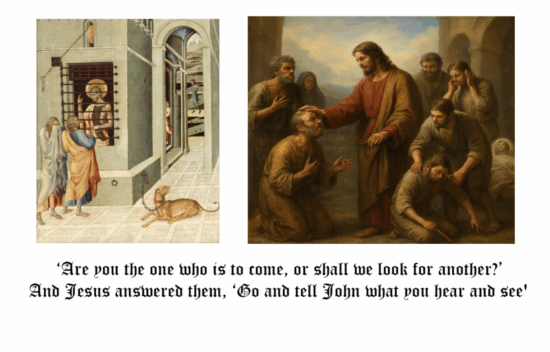
Isaiah tells us that the coming of our God is like an oasis in the desert, like a cure for those who are crippled and struck down. And John the Baptist reminds us that if we want to know whether God really is close by, then we only need to look around us and see the wonders that can happen when the Good News is proclaimed.
And this coming of our God is not merely some distant thing in the future that can have no effect on our lives today. God comes every day. We meet Christ in those whose lives touch ours, both friend and stranger. He looks out on us through the eyes of our smiling grandchildren as much as the tears of the widow and orphan.
The coming of our God is nothing to fear. It is something to look forward to eagerly, both now and at the end of time.