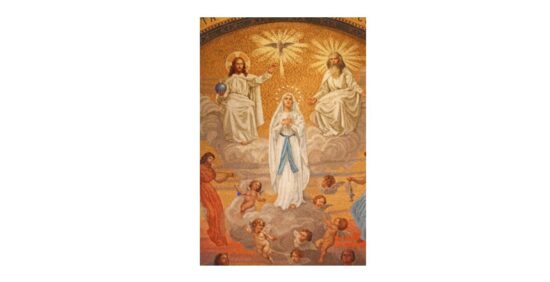
O gloriosa domina photo by Fr Lawrence Lew on flickr
Mary’s credentials
The Feast of the Assumption proclaims that at the end of her life on earth Mary was taken up body and soul to Heaven to be rewarded for her lifetime of faithfulness in serving God by bearing His only Son, Jesus of Nazareth who was the Christ of God.
We call Mary “full of grace” or the “highly favoured one”. What qualified her to be shown such favour by God?
Mary was a girl who would not have stood out from the crowd. We could almost call her a nobody, in the best sense of the word. She was a teenager getting on with her life in a backwater village in the Middle East. As far as we know she had no special qualifications. It is more than likely that she couldn’t read and that like most girls at the time she would have busied herself with taking care of the household, waiting for the day when her wedding would take place to the man her family had arranged for her to marry. Did she have what was necessary for God’s plan?
She was humbled and troubled when the angel Gabriel visited her. Yet she was open to what God was asking of her, even though she didn’t fully understand how it could be.
Her humility shines out in her song, the Magnificat. And so does her praise. For when she had listened to what the angel had to say, her immediate reaction was to praise God for using her in this extraordinary way.
If we are to follow the pattern Mary has set us as a model of faith then we can learn much from the way she behaves. Are we open and attentive to what God is asking of us in our lives? How do we listen to God? How do we know what’s being asked of us? Do we let our false humility get in the way of serving God or do we make ourselves available so that God can work through us, doing far more than our own efforts can achieve?
And do we praise God for the graces that we constantly receive or do we see our life as simply the unfurling of fate? Mary is given to us as a model of worship with her hymn of praise to God. Our prayer today is that where she has gone we may one day follow.